sincere ceremonies
  • Home
  • About
    • Meet Karen
  • Services
    • Funerals
    • Weddings
    • Direct Cremation Ceremonies
  • Blog
    • Funeral Blog
    • Wedding Blog
  • Resources
    • Funeral Resources >
      • FAQs
      • Funeral Resources
  • Contact
  • Home
  • About
    • Meet Karen
  • Services
    • Funerals
    • Weddings
    • Direct Cremation Ceremonies
  • Blog
    • Funeral Blog
    • Wedding Blog
  • Resources
    • Funeral Resources >
      • FAQs
      • Funeral Resources
  • Contact
Search by typing & pressing enter

YOUR CART

Funeral blog
This funeral blog explores ceremony as an intentional, meaningful act.
It offers practical guidance on ritual, words, and participation, for families who want funerals that feel honest, grounded, and true to the life being remembered.
Picture
©KarenBrady
contact karen

monthly posts

December 2025
November 2025
October 2025
September 2025
August 2025
July 2025
June 2025
May 2025
April 2025
March 2025
February 2025
January 2025

1/12/2025 2 Comments

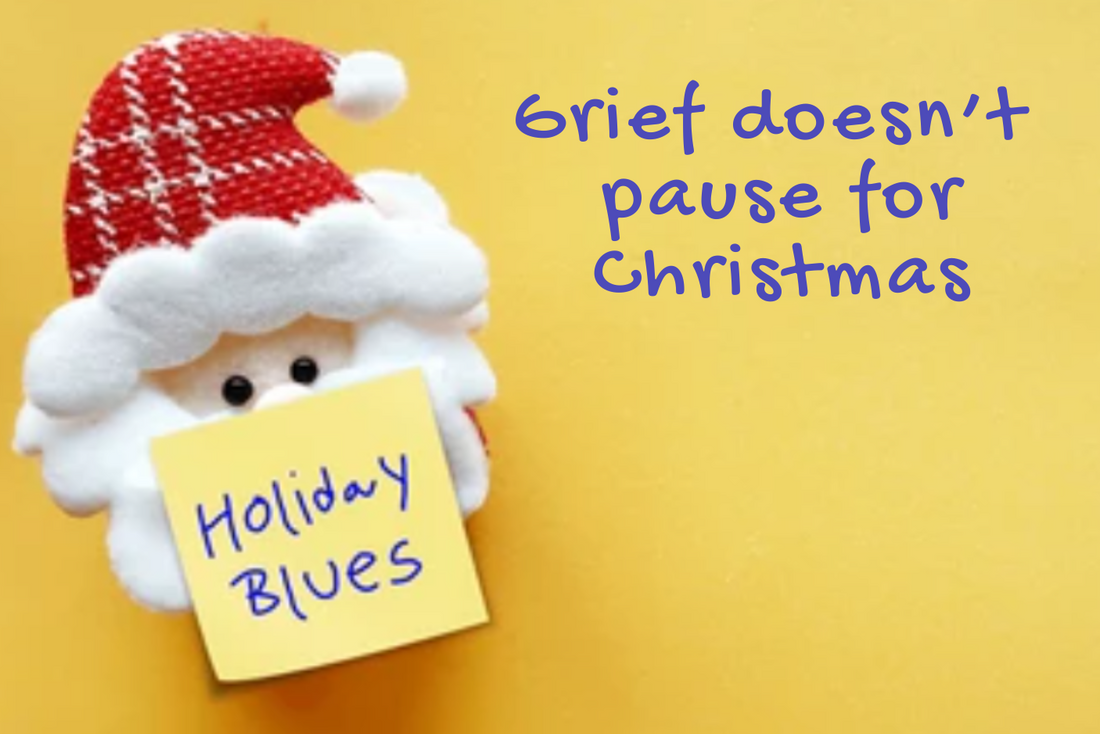
Grieving at Christmas: How Ritual Helps Us Through the Loneliest Seasons

December carries a particular emotional weight. Streets glow with lights, shops pulse with music, and the world around us seems to agree on one shared message: be joyful. And yet, for many people, the holiday season is one of the hardest times to navigate after someone has died.
Grieving at Christmas can feel like you’re living in two worlds at once. One part of you might reach for moments of connection or celebration, while another part aches with the sharpness of absence. If this is you, you are not alone, and there is nothing wrong with how you feel.

Why grief can intensify during the festive season
Psychologists and bereavement researchers (including Worden, Stroebe & Schut, and the ongoing continuing bonds approach) note that anniversaries, seasonal rituals, and cultural expectations can bring grief into sharper focus. The festive season is particularly potent because it marks:
  • The end of a calendar cycle
  • Collective rituals around family and togetherness
  • Memories tied to past holidays and traditions
  • A sense of contrast between inner experience and outer celebration

This tension, the world urging joy while your internal world is carrying pain, often deepens the experience of grief.

Anthropologists such as Arnold van Gennep and later Victor Turner also remind us that humans use ritual at times of transition. December is a natural threshold: symbolic, reflective, and emotionally charged. When someone important is no longer physically present, those symbolic moments underscore the change.

How ritual supports us through lonely seasons
Ritual isn’t just something we “do” at funerals. Ritual is a human instinct, a way of making sense of change, expressing emotions, creating connection, and grounding ourselves. Ritual can be private or communal, simple or symbolic, ancient or deeply personal.

Across cultures and time, ritual has been used to:
  • provide structure when life feels chaotic
  • honour identity and relationship
  • acknowledge transitions
  • create space for grief
  • support connection and belonging
  • soothe the nervous system through repetition

As van Gennep’s rites of passage model suggests, we move through separation → liminality → reintegration. Grief places us firmly in a liminal space, between what was and what is now. Ritual gives us stepping stones across that uncertain ground.

Creating personal rituals for grieving at Christmas
When grief intensifies during the holidays, creating your own rituals can offer comfort, stability, and meaning. These rituals don’t have to be elaborate. They simply need to feel true to you.

Here are gentle ideas you may find supportive:

✨ Light a candle at dusk on Christmas Eve
Let the warm glow represent connection, love, memory, or gratitude, whatever speaks to you. A few moments of silence can be grounding.

✨ Place a meaningful ornament on the tree or in your home
This could be:
  • a photo
  • a handwritten message
  • a small object that symbolises something they loved
  • something you craft yourself
Ritualising this act each year can gently honour your enduring relationship.

✨ Create a quiet moment to speak their name
It can be around the dinner table, during a walk, or while looking out at the night sky. Speaking someone’s name is a powerful acknowledgment of their significance.

✨ Play one of their favourite songs
Music connects emotionally and physiologically, studies show it can regulate mood and evoke memory in ways that bring comfort.

✨ Story sharing
Telling stories about someone keeps their impact alive. Many grief researchers now affirm that maintaining an ongoing connection, known as “continuing bonds”, is healthy, normal, and part of remembering.

​✨ Blend old traditions with new ones
Some traditions may feel too painful. Others may be deeply comforting. It’s okay to keep some, adapt others, or create new rituals that reflect how your life has changed.

When joy and grief co-exist
A common concern people share is that laughing, smiling, or enjoying a moment during the holidays might somehow dishonour their pain, or the person who died. But joy arising does not diminish or erase grief. It simply means you are human and capable of holding more than one feeling at a time.

Grief isn’t linear. It’s a companion that ebbs and flows. You can experience warmth, humour, or gratitude even while grieving. It’s not a betrayal of your pain; it’s an expression of your resilience.

If you are supporting someone who’s grieving at Christmas
Your presence can be more healing than any perfect words.
Gentle phrases that help:
  • “I’m thinking of you.”
  • “This time of year can be tough, I’m here.”
  • “Would you like company, or some quiet space?”
  • “If you need anything practical done, I’m happy to help.”

Phrases to avoid:
  • “Try to enjoy yourself.
  • “They’d want you to be happy.”
  • “You should come, it will cheer you up.
  • “Aren’t you over the worst of it by now?”

Let people feel what they feel, without pressure to be festive or strong.

A gentle reminder for December
If the holiday season feels heavy, you are not doing anything wrong. Grief is part of living, and it shows the depth of your connection. You’re allowed to rest, to step back, to prioritise quiet, or to engage only with what feels manageable. Rituals, no matter how small, can be a source of comfort and anchoring.

May this December bring you moments of softness, a sense of being held by your memories, and the freedom to honour your grief in your own way.

If this blog resonated with you, or if you have your own experiences of navigating grief at Christmas, I’d love to hear from you. Please share your thoughts or stories in the comments below, your voice can help others feel seen and understood.

References
  1. Worden, J. W. (2018). Grief Counseling and Grief Therapy: A Handbook for the Mental Health Practitioner (5th ed.). Springer Publishing.
    (Staged tasks of mourning widely used in bereavement theory.)
  2. Stroebe, M., & Schut, H. (1999). The Dual Process Model of Coping with Bereavement: Rationale and Description. Death Studies, 23(3), 197–224.
    (Explains oscillation between loss-oriented and restoration-oriented coping.)
  3. Klass, D., Silverman, P., & Nickman, S. (Eds.). (1996). Continuing Bonds: New Understandings of Grief. Taylor & Francis.
    (Foundational work establishing that maintaining a connection after death is normal and healthy.)
  4. van Gennep, A. (1960). The Rites of Passage. University of Chicago Press. (Original work published 1909.)
    (Introduces the separation → liminality → reintegration model.)
  5. Turner, V. (1969). The Ritual Process: Structure and Anti-Structure. Aldine Publishing.
    (Expands on van Gennep’s work and explores liminality, communitas, and symbolic action.)
  6. Juslin, P. N., & Sloboda, J. A. (Eds.). (2010). Handbook of Music and Emotion: Theory, Research, Applications. Oxford University Press.
    (Research on music as emotional regulation and memory.)
  7. Levitin, D. J. (2006). This Is Your Brain on Music: The Science of a Human Obsession. Dutton.
    (Accessible overview of how music influences mood, memory, and emotion.)
  8. Australian Centre for Grief and Bereavement (ACGB).
    General resources on grief reactions and holiday-related triggers.
  9. Grief Australia.
    Educational material on grief, ritual, and coping during significant dates.
  10. Hospice UK.
    Guidance on managing grief and emotional triggers around holidays and anniversaries.
2 Comments

19/11/2025 0 Comments

What Is Death Literacy, and Why Does It Matter?

We live in a culture that often avoids talking about death. Euphemisms soften it, medical systems manage it, and too often, families are left unprepared when death touches their lives. Yet death is universal, and so too should be our ability to understand, navigate, and engage with it. This is where death literacy comes in.

Defining Death Literacy
The term “death literacy” was first developed by Associate Professor Debbie Horsfall and colleagues (2017) as part of community-based research into end-of-life care. They describe it as the knowledge and skills that people and communities need to access, understand, and act on end-of-life and death care options.

It is more than facts or paperwork. Death literacy is:
  • Practical knowledge: understanding care options, funeral choices, legal rights, and available resources.
  • Emotional literacy: finding language to talk about loss and creating space for meaningful conversations.
  • Community wisdom: drawing on traditions, rituals, and cultural practices that connect people across generations.

Just as literacy in reading and writing is not only about the individual but also about how whole societies function, death literacy is best understood as a collective skill.

Why We Need It
Historian Philippe Ariès (1974) described Western culture as shifting from a time when death was communal and familiar, to one where it has become hidden, professionalised, and sanitised. Tony Walter (1994) has similarly shown how modern societies struggle with grief because the rituals and shared practices that once guided us have weakened.

The result is that many people feel disempowered at the very moment they most need confidence and clarity. Decisions are often made quickly, by default, or under pressure, with little opportunity to reflect on what feels right.

When death literacy is low, we rely heavily on institutions and professionals. When it is strong, families and communities can:
  • Plan ahead, easing stress at the time of death.
  • Express wishes and values clearly, and have them respected.
  • Support one another in grief, without always outsourcing care.
  • Explore sustainable, family-led, and culturally grounded options.

Avoiding the Word “Death”
One clear marker of low death literacy is our language. We often say someone has “passed away” or “gone to a better place,” instead of simply naming death. While euphemisms can feel gentle, they can also reinforce avoidance. If we cannot name death, how can we learn to live with it?

I’ve written a whole blog on this very topic, the way our discomfort with the word “death” shapes our conversations, rituals, and choices. Read my blog here. It is part of a broader cultural pattern: we avoid the subject, and in doing so, we deny ourselves the opportunity to prepare.

Building Death Literacy Together
Death literacy is not learned from a single book or workshop. It grows through lived experience, sharing stories, and having the conversations we often try to avoid. Some ways to build it include:
  • Talking openly with friends and family about wishes, values, and fears.
  • Learning about end-of-life care, funerals, and memorial options.
  • Participating in initiatives such as Dying to Know Day, death cafés, or community workshops.
  • Exploring ritual and meaning through culture, creativity, or personal ceremony.

As an Independent Funeral Celebrant, I aim to support this collective learning through:
  • Workshops on end-of-life planning where people can explore their values and document their wishes.
  • Death Cafés and community conversations that create space for honesty and connection.
  • Hands-on activities like coffin or shroud decorating, ritual creation, and sustainable death care practices.
  • Ceremony and ritual design that reflects the individuality of each person and the community around them.

I don’t have events scheduled right now, but if you’d like to see one in your community, I’d love to hear from you. Together we can create spaces where these important conversations can happen. Please contact me here.

A Public Health Issue
Allan Kellehear (2005) has argued that dying, death, and loss are not just medical matters, but public health issues. Just as we promote literacy in nutrition or exercise, we need to build literacy in death, because it affects every one of us.

Communities with strong death literacy are more resilient. They know how to support people at the end of life, how to grieve together, and how to honour their dead in ways that feel meaningful. This is not only healthier for individuals, it is healthier for society.

A Collective Skill
Just as talking about sex won’t make you pregnant, talking about death won’t kill you. But silence can leave us completely unprepared. A little honesty goes a long way, it gives us room to prepare, to shape endings that feel right, and to build communities that know how to carry one another.

I’d love to know what death literacy means to you. What have you learned, or what do you wish more people talked about? Share your thoughts in the comments below.

1. Horsfall, D., Noonan, K., & Leonard, R. (2017). Death literacy: A conceptual framework for enhancing end-of-life care.
2. Leonard, R., Noonan, K., Horsfall, D., Kelly, M., Rosenberg, J., Rumbold, B., et al. (2019). Death Literacy Index: A report on its development and implementation. Western Sydney University.
3. Ariès, P. (1974). Western attitudes toward death: From the Middle Ages to the present. Johns Hopkins University Press.
4. Walter, T. (1994). The revival of death. Routledge.
5. The Groundswell Project. (2023). Dying to Know Day. The Groundswell Project Australia. 
6. Death Cafe Website
7. The Role of Ritual and the Power of Symbolism
8. Kellehear, A. (2005). Health-promoting palliative care: Developing a social model for practice. Routledge

0 Comments

16/10/2025 1 Comment

Why We Need to Stop Fighting Death

In Western culture, death is often described as something to be fought, beaten, or defeated. How often have you heard about those who “beat the odds” or are “battling on”? We rarely stop to question this language, but the metaphors we use matter.

The way we talk about dying reveals how we understand it — and in our current framing, dying has been recast as a medical failure rather than a natural part of life.

The Medicalisation of Dying
Throughout most of human history, death was recognised as an inevitable stage of life. It was embedded in culture, ritual, and community (Ariès; van Gennep). But over the past century, medicine has come to dominate the end of life.

Sociologist Allan Kellehear reminds us:

“Death has become the province of doctors, and dying is increasingly defined as a medical event, rather than a social or spiritual one”.

This medicalisation has many consequences:

  • Focus on intervention: Every stage of decline is treated as a condition to be managed, measured, or delayed.
  • Endless treatment options: Technology makes it possible to extend life far beyond what was once imaginable, but this often prolongs dying rather than living.
  • Marginalisation of the social and emotional: By treating dying as a medical problem, we risk overlooking the relational, cultural, and spiritual dimensions that give it meaning.

As Ivan Illich warned in his classic work Medical Nemesis:

“A society that lives by medical categories lives by values which constantly expand the domain of medicine, and thereby continuously shrink the domain of personal autonomy” .

The Language of War
One of the most striking features of our cultural shift is the way we describe illness and death using the language of war. As Susan Sontag argued in Illness as Metaphor:

“The controlling metaphors in descriptions of cancer are, in fact, drawn from the language of warfare: cancer cells do not simply multiply; they are ‘invasive’… treatment is a ‘battle’”.

The problem with this framing is that it sets up death as defeat. If survival is victory, then dying becomes failure — and those who die may even feel they have “let others down” by not fighting hard enough.

This language also discourages acceptance. It suggests that to stop treatment is to surrender, and to surrender is shameful. In this way, battle metaphors reinforce the medicalisation of dying, casting it as a problem to be overcome, rather than a reality to be lived.

The Body Knows How to Die
Yet dying is not just a medical event. Our bodies carry the knowledge of how to die, just as they carry the knowledge of how to grow, age, and heal.

End-of-life clinicians, doulas, carers, and families often speak of recognising the body’s natural processes as it begins to let go: changes in breathing, withdrawal from food, altered consciousness. These are not signs of failure but part of the body’s wisdom in its final transition.

As palliative care pioneer Dame Cicely Saunders put it:

“You matter because you are you, and you matter to the last moment of your life. We will do all we can, not only to help you die peacefully, but to live until you die”.

Reclaiming this understanding — that death is not a battle but a process our bodies already know — allows us to approach dying with less fear and more compassion.

Voluntary Assisted Dying and the Medical Frame
The legalisation of voluntary assisted dying (VAD) in parts of Australia and internationally has sparked deep debate. For some, it represents compassion and choice in the face of unbearable suffering. For others, it raises difficult ethical and spiritual questions.

Philosopher Margaret Battin notes:

“When medicine has the power to prolong dying indefinitely, the possibility of choosing the time and manner of death can itself become a form of liberation”.

Recent studies in Australia show that many people who seek VAD do so for reasons beyond physical pain. Autonomy, fear of future suffering, and concerns about dignity or social burden often weigh just as heavily (BMJ Supportive & Palliative Care). These findings underline that VAD is about more than medicine — it is about meaning.

Yet paradoxically, the framework for VAD reinforces medicine’s central role. Eligibility is assessed through strict medical criteria. The process requires doctors, paperwork, and protocols. Even the decision to die must be mediated through medical systems (Okninski).

This highlights the importance of the non-medical roles around the dying person. Families, end-of-life doulas, and carers remind us that dignity and support are not only clinical matters. They offer the relational, emotional, and spiritual care that medicine alone cannot provide. Their presence helps re-balance death as not just a medical event but a profoundly social one.

Reframing Death as Part of Life
If we want to reclaim a healthier relationship with death, we must shift away from war metaphors and medical dominance. That doesn’t mean rejecting medicine — but it does mean resisting the idea that death is a medical failure.

Talking openly about dying, acknowledging the body’s natural wisdom, and creating spaces for ritual and community can help us remember:
  • Death is not the enemy.
  • Dying is not defeat.
  • Life’s end is not a battle to win or lose, but a transition we all share.

Join the Conversation
How do you feel about the way we frame dying in our culture?
Do you think war metaphors and medical dominance help or hinder our ability to face death?
And how do you see the role of family, carers, and doulas in reshaping the experience of dying?
​
I would love to hear your thoughts in the comments below.

References
  1. Ariès, P. (1981). The Hour of Our Death. New York: Knopf; van Gennep, A. (1960). The Rites of Passage. Chicago: University of Chicago Press.
  2. Battin, M. (1998). The Least Worst Death: Essays in Bioethics on the End of Life. Oxford: Oxford University Press.
  3. Illich, I. (1975). Medical Nemesis: The Expropriation of Health. New York: Pantheon.
  4. Kellehear, A. (2007). A Social History of Dying. Cambridge: Cambridge University Press.
  5. Okninski, M. (2023). Voluntary Assisted Dying in Australia — Key Similarities and Points of Difference Concerning Eligibility Criteria in the Individual State Legislation. Journal of Bioethical Inquiry, 20, 337–351. https://doi.org/10.1007/s11673-023-10228-9
  6. Saunders, C. (2005). Watch with Me: Inspiration for a Life in Hospice Care. Sheffield: Mortal Press.
  7. Sellars, M., et al. (2025). Does voluntary assisted dying impact quality palliative care? A national cohort study of motivations and consequences of VAD enquiries. BMJ Supportive & Palliative Care. Published online first: 14 September 2025. https://doi.org/10.1136/spcare-2024-004946
  8. Sontag, S. (1978). Illness as Metaphor. New York: Farrar, Straus and Giroux.
1 Comment

23/9/2025 0 Comments

The Quiet Power of Vigil and Sitting With the Body

In the hours and days after someone dies, there’s often a rush of logistics;
phone calls to make and arrangements to consider.
In all of this, it can be easy to overlook something incredibly simple and deeply human:
the act of just sitting with the body.

Before commercialised death care became the norm,
it was common, expected, even, for family and friends to keep vigil at home.
The person who had died would be washed, dressed, and laid out in a familiar room,
often with candles or flowers nearby.
People would come and go,
bringing food,
sharing stories,
holding hands,
​sitting quietly.

Today, more families are rediscovering the quiet power of these old practices.

Step one: put the kettle on
When someone dies, my number one rule is this: put the kettle on.

Before you rush to make arrangements, before you ring a funeral director, PAUSE…
Make a cuppa…
Let yourself breathe…
Your person has died, and you are not required to hand them over immediately.

You can take a moment. You are allowed to.

Sitting with the body gives you time to process, to be present,
and to start the grieving process in your own way, at your own pace.

Time slows down
There is something profoundly grounding about sitting beside the body of someone you love.
The pace changes. There’s no rush to speak. No need to “move on.” Instead, you are simply with them,
bearing witness to the truth of their death, and beginning, in your own time, to say goodbye.

This can be particularly helpful when death has come suddenly,
or when the relationship was close, complicated, or layered.
Having time to touch their hand, brush their hair, or place a letter or drawing nearby
can do what words alone struggle to do.

A chance to begin grieving
Psychologically and emotionally, our minds often need time to catch up with the reality of death.
Sitting with the body can support this gentle shift.
It helps the loss move from the abstract (“They’ve gone”),
to the real (“They are here, and they are no longer breathing”).

This moment, however brief, becomes a threshold.
It is where the ritual of parting begins.
It’s where memories arise, where tears may fall,
and where laughter can unexpectedly bubble up as stories are shared.

A vigil can be whatever you need it to be
Some people light candles.
Some play favourite music, or read poetry.
Others sit in silence or rotate through quietly, each person having their own moment.
There is no right or wrong way.
What matters is that the time is yours.

And it can happen anywhere; at home, in a hospital room, in a chapel,
even at a funeral home (willing to support family-led care).
Some people spend hours.
Others find a few moments is enough.
Some invite others in; and
Some prefer to be alone.

Children can place drawings on their grandmother’s chest.
Friends can sit in easy silence, wrapped in blankets, through the night.
Families can gently help dress their person in their favourite clothes, adding a sprig of rosemary to their lapel.

These small gestures,
full of meaning,
full of caring,
begin to weave ritual into grief.

Not everyone will want this
And that’s okay, too.

Some people find comfort in stepping away,
in remembering the person as they were in life.
For others, the idea of being near the body may feel confronting or unfamiliar.
There is no obligation, no pressure,
only the invitation to consider what might bring comfort, meaning, and a sense of presence.

A quiet return to something old and wise
Reclaiming the practice of sitting with the body is not about romanticising the past.
It’s about making space.
Space for grief, for connection.
Space to be with death in a way that is gentle, unhurried and real.

You are allowed to take time.
You are allowed to be with your person.

Sometimes, it is in these still, quiet hours that the deepest healing begins.

Have you experienced a home vigil, or spent time with someone after they died?
What did it feel like for you?
Would you consider it for yourself?

You are warmly invited to share your reflections in the comments.
0 Comments

12/8/2025 0 Comments

Music That Moves Us: Choosing Music for a Funeral Ceremony

There’s a moment in many funerals when the first notes begin to play — and the air itself seems to shift.

Conversation fades. A hush falls. You can almost feel the collective breath of the room as memories rise unbidden — a dance floor in summer, a childhood bedroom, the passenger seat of an old car, a hand held in the dark.

Music has a way of slipping past the mind’s guard and going straight to the heart. It can hold a whole life inside three minutes, carrying joy, grief, love, and memory in the same breath. That’s why it so often becomes one of the most powerful parts of a farewell.

Why music matters...

Words can falter when we’re grieving. Music doesn’t ask for permission; it moves through us, unlocking emotion we didn’t know was waiting.

Funeral music can:
  • Honour the person — reflecting their spirit, quirks, and loves
  • Hold space for grief — allowing mourners to feel without explanation
  • Create connection — binding everyone present in a shared emotional moment
  • Mark transitions — guiding the ceremony from one stage to the next

Music is also a safe emotional container. A song has a beginning, middle, and end — giving structure to feelings that otherwise feel too big or formless (Garrido, 2016; Hanser, 2021).

Choosing music: guidance from the heart

Picking music for a funeral can feel daunting. There’s no right or wrong — only what feels true. Here are some ways to approach it:

  • Start with the person – What did they love to listen to? Was there a song they sang loudly in the car, or a piece of music that always made them pause and listen?
  • Think about the moment – Music can serve different purposes in a ceremony: welcoming people in, creating a reflective pause, accompanying a photo tribute, or lifting the energy as people leave.
  • Consider the tone – Gentle and contemplative? Bold and celebratory? A touch of humour? The tone you choose will shape the emotional arc of the service.
  • Involve others – Invite family and friends to share songs that remind them of the person. This can spark meaningful stories you might include in the ceremony.
  • Pair music with memory – Sometimes the most moving moments come when a piece of music is introduced with a short story about why it mattered.
  • Trust your instinct – If a song makes you stop, breathe, and feel, that’s worth paying attention to.

Research shows…
  • Listening to music activates brain regions linked to emotion, memory, and reward, releasing dopamine and lowering stress hormones (Koelsch, 2014; Chanda & Levitin, 2013).
  • In bereavement, music can help regulate emotion, provide comfort, and create a sense of connection, even through sadness (Garrido & Schubert, 2013; Hanser, 2021).
  • Anthropologists have found that across cultures, music has always been central to death rituals, helping individuals and communities navigate the transition between life and death (Becker, 2004).

A final note

You don’t have to find the perfect song — just one that feels honest. Something that holds a fragment of your person’s story.

As a celebrant, I’ve seen music do what no eulogy could — opening a space where people feel seen in their grief and connected to each other.

If you’re unsure where to begin, make tea, gather with those who loved them, and listen together. Let the songs lead you. You might be surprised at what rises to the surface.

References:
Becker, J. (2004). Deep Listeners: Music, Emotion, and Trancing. Indiana University Press.
Chanda, M. L., & Levitin, D. J. (2013). The neurochemistry of music. Trends in Cognitive Sciences, 17(4), 179–193.
Garrido, S. (2016). Why Are We Attracted to Sad Music? Palgrave Macmillan.
Garrido, S., & Schubert, E. (2013). Benefits of music training and listening for people with post-traumatic stress disorder. Arts in Psychotherapy, 40(4), 433–440.
Hanser, S. B. (2021). Music Therapy: A Guide to Clinical Practice. Routledge.
Koelsch, S. (2014). Brain correlates of music-evoked emotions. Nature Reviews Neuroscience, 15(3), 170–180.
0 Comments
<<Previous

    ©️Karen Brady

    Blog history

    All

    RSS Feed

    sincere ceremonies
    Picture
    Home     Services     Direct Cremation and Grief     About      FAQs    Resources    Testimonials    Contact​
Site powered by Weebly. Managed by CheaperDomains.com.au